Japanese Breakfast Food: What to Expect When Eating in Japan
The first time most visitors encounter a proper Japanese breakfast — one of the most rewarding parts of the Japan food guide — they’re surprised — not because it’s strange, but because it’s so complete. Rice, miso soup, a piece of grilled fish, a small dish of pickles, soft-boiled or rolled egg, maybe a side of simmered vegetables. It’s designed to sustain rather than simply fuel, and it works in a way that a coffee and a piece of toast doesn’t.
Japan’s breakfast culture varies depending on where you eat it — a ryokan inn in the mountains, a city hotel, a neighbourhood coffee shop, or a convenience store at 7am. Each setting produces something different, but the underlying philosophy is consistent: breakfast in Japan is worth taking seriously.
This guide covers what’s actually in a Japanese breakfast, where to eat one, and how the experience differs across settings — aimed at travellers, not home cooks.
The Traditional Format: Ichi-ju San-sai
The framework that underpins Japanese breakfast — and many Japanese meals — is ichi-ju san-sai: one soup, three sides. In practice for breakfast, this means:
- Steamed white rice (gohan): The foundation. Not a side dish — the centre of the meal.
- Miso soup (miso shiru): Made from dashi stock and fermented miso paste, with additions like tofu, wakame seaweed, spring onion, or clams depending on the region and season.
- A protein: Usually grilled salted salmon (sake), mackerel (saba), or grilled chicken. At higher-end establishments, you might receive chilled tofu or a small portion of sashimi instead.
- Tamagoyaki: A sweet, rolled omelette, cooked in a rectangular pan and cut into slices. Slightly sweet, slightly salty, much better than scrambled eggs.
- Pickles (tsukemono): Fermented or vinegar-pickled vegetables — cucumber, radish, plum. Provide acidity to balance the heavier elements.
- Supplementary dishes: At ryokan and hotel breakfasts, additional small dishes often appear — simmered tofu, hijiki seaweed salad, a small dish of natto (fermented soybeans), cold silken tofu with grated ginger.
The portion of each element is small. The combined effect is not. A proper Japanese breakfast keeps you full until mid-afternoon without heaviness.
Ryokan Breakfast: The Full Experience
If you’re staying at a ryokan — a traditional Japanese inn — breakfast is one of the reasons to do it. It arrives as an event. You sit at a low table, often in a tatami room or a dining room with views of a garden, and multiple small dishes appear, some served in lacquerware, some in ceramic bowls selected for the season.
A ryokan breakfast typically includes everything described above, plus regional specialities that reflect where you are. In Kyoto (see the Osaka and Kyoto food culture), you might receive kyo-ryori-influenced dishes — precisely cut seasonal vegetables prepared with restraint. In a coastal inn, fresh grilled fish caught that morning. In Hokkaido, dairy makes an appearance that it doesn’t in most of Japan — butter, cream, fresh milk.
The tea served at a ryokan breakfast — green tea (ocha), hojicha (roasted green tea), or bancha depending on the establishment — is taken seriously. It’s not a bag in a mug. Refills come without asking.
Ryokan breakfast is part of Japanese food culture at its most considered — typically included in the room rate as part of an overnight package. It usually begins at 7:30 or 8:00am and runs until 9:30 or 10:00. Don’t skip it.
Hotel Breakfast: Western and Japanese Options
Most Japanese business hotels and city hotels offer a breakfast buffet with both washoku (Japanese-style) and yoshoku (Western-style) options. The Japanese section typically includes rice, miso soup, grilled fish, pickles, tamagoyaki, and natto. The Western section includes toast, eggs, salad, and coffee.
The Japanese section is always worth prioritising. The fish is usually good — hotels source it properly because breakfast matters in Japan in a way it doesn’t in most countries. The miso soup is made fresh. The rice is cooked correctly.
One note: miso soup at a hotel buffet suffers from sitting in a pot. Get it first, while it’s fresh. The fish and tamagoyaki hold better.
Some higher-end hotels — particularly those in Kyoto, Kanazawa, and Kyushu — offer the full traditional breakfast as a dedicated service rather than a buffet. These are worth booking specifically. The Four Seasons Kyoto, Hoshinoya, and Hoshino Resorts properties do this particularly well, but well-regarded smaller hotels in onsen towns often match or beat them.
Kissaten: The Morning Set
If ramen is Japan’s most celebrated meal, the kissaten morning set is its most quietly underrated. Kissaten (喫茶店) — old-school Japanese coffee shops, distinct from modern café chains — are one of the best things in Japan that almost no travel guide tells you about.
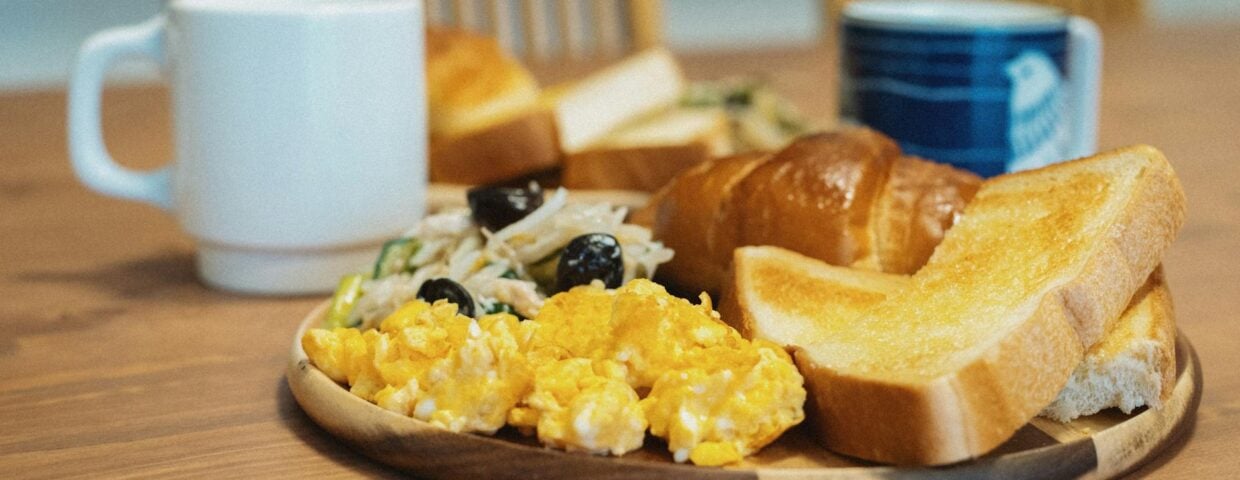
Most kissaten open early, between 7:00 and 8:00am, and offer a morning set (mōningu setto): coffee plus a small breakfast package, for the price of the coffee alone. The standard morning set is a cup of drip coffee or blend coffee, a thick slice of white toast (sometimes with butter and jam, sometimes with a small salad or egg), and a hard-boiled egg or tamagoyaki.
The value is extraordinary — ¥400–600 for a complete breakfast. The atmosphere is equally so. Kissaten are unhurried places, full of older regulars who have been coming every morning for decades. Nobody is rushing you. The coffee is strong and comes in a proper cup.
Nagoya has elevated kissaten morning culture to an art form. The Nagoya Morning is a regional institution — pay for coffee, receive an elaborate spread that can include red bean paste (ogura), small salads, fruit, soup, and additional toast. Some Nagoya kissaten have been expanding their morning sets competitively for decades. It’s worth planning a morning around.
Finding good kissaten: look for the word 喫茶 (kissa) on the sign, or the old-fashioned interior visible through the window — dark wood, counter seating, a coffee machine that looks like it predates smartphones. Avoid anything with Starbucks-style branding.
Convenience Store Breakfast
Japan’s convenience stores — 7-Eleven, Lawson, FamilyMart — deserve mention here, because a convenience store breakfast in Japan is a meaningfully different thing from a convenience store breakfast anywhere else.
The core: onigiri (rice balls, filled with salmon, tuna mayo, pickled plum, or seasoned kelp), sold fresh and constantly restocked. A container of warm miso soup from the soup section. A boiled egg. A small salad. Coffee from the machine. Total cost: ¥400–600.
The onigiri are made to be eaten immediately — the seaweed is separated from the rice by a clever plastic divider, which you peel away just before eating to keep the nori crisp. The technique matters: pull tab 1, then 2, unwrap carefully. It sounds trivial. Getting it wrong in front of a queue is not.
For early morning travel days, shinkansen platforms, or any morning where the hotel breakfast is overpriced and uninspiring, the convenience store breakfast is the answer. See the Japan convenience store food guide for the full rundown.
What’s Actually in a Japanese Breakfast: The Dishes
Miso soup (miso shiru): Dashi stock — made from kombu seaweed and katsuobushi (dried bonito) — forms the base. Miso paste is added off the heat. Contents vary by region: silken tofu and wakame in the Kanto east, clams or asari in coastal areas. Note for vegetarians: standard dashi contains fish. Kombu-only dashi exists but isn’t the default.
Tamagoyaki: The Japanese rolled omelette is made in a specific rectangular pan, with thin layers of egg rolled over each other. The recipe varies: sweet (dashi maki tamago) or savoury. Both are correct. The skill is in the even roll and the smooth surface. It looks simple and isn’t.
Grilled fish: Usually salted overnight and then grilled skin-side-up. Salmon (sake) and mackerel (saba) are the most common. The salt draws out moisture and concentrates the flavour. Eaten with grated daikon radish (daikon oroshi) and a small amount of soy sauce.
Pickles (tsukemono): The acidity is functional — it resets the palate between bites of rice and fish. Yellow pickled radish (takuan), pink pickled ginger (beni shoga), and umeboshi (pickled plum — intensely sour, not for everyone) are the most common.
Natto: The most divisive element of a Japanese breakfast. Fermented soybeans — sticky, stringy, pungent. Standard at ryokan and hotels, often with a small packet of karashi mustard and tare sauce. You stir it with chopsticks until it becomes more stringy, then eat over rice. Eastern Japan embraces it; western Japan is more ambivalent. For more on natto specifically, see the natto guide.
Where to Eat Japanese Breakfast
Ryokan (any region): The best version. Worth planning a one-night stay around. The onsen-ryokan combination — hot spring bath, elaborate dinner, traditional breakfast — is one of the better things Japan offers.
Kissaten (Nagoya, Tokyo, Kyoto): Nagoya for the spectacle of the morning set. Tokyo’s Koenji, Shimokitazawa, and Yanaka neighbourhoods for the atmosphere. Kyoto for the older, quieter versions near temples.
Depachika (department store basement) food halls: Not breakfast per se, but morning-market-style purchases of high-quality tamagoyaki, rice balls, and prepared dishes are possible. Best in Tokyo (Isetan Shinjuku, Mitsukoshi Ginza) and Osaka.
A Note for Travellers With Dietary Needs
Standard Japanese breakfast contains fish (both the grilled protein and dashi in miso soup). If you’re vegetarian or vegan, communicate this in advance at ryokan and hotels — most can substitute. The convenience store has plant-based onigiri options. See the vegetarian and vegan Japan guide for practical phrases and what to specify.
For gluten-free travellers: miso soup and most breakfast dishes are naturally gluten-free, but soy sauce (used in some tamagoyaki and fish preparations) contains wheat. See the gluten-free Japan guide for what to check.
Japanese breakfast is part of a food culture that treats every meal as an occasion worth the effort. For the full picture of eating in Japan — from ramen counters to convenience stores — start there.
External reference: Japan Travel: Traditional Japanese Breakfast — the official tourism board’s overview of what’s served and where.