Wagyu Beef in Japan: Grades, Brands, Where to Eat It, and What It Actually Costs
The beef at #2 on Reddit’s Japan travel subreddit, every week, is some variation of: “where should I eat wagyu in Japan?” The answers are always half correct and often miss the most important things — that not all wagyu is the same, that where you eat it matters as much as which cut you order, and that you don’t need to spend ¥30,000 to eat extraordinarily well.
Wagyu eaten in Japan is a different experience from wagyu eaten anywhere else, because the supply chain is completely different. The top-grade cuts — A5 from the most celebrated prefectures — rarely leave Japan in meaningful quantities. What’s sold internationally as Japanese wagyu, or labelled “Kobe beef,” is almost never the real thing. The real thing stays here.
This guide explains what wagyu actually is, how to understand the grades and brands, how to eat it, and where to find it at prices that won’t require you to justify it to your accountant. For the full picture of eating in Japan, start there.
What Wagyu Actually Means
Wagyu (和牛) translates literally as “Japanese cow.” It refers to four specific Japanese cattle breeds: Japanese Black, Japanese Brown, Japanese Shorthorn, and Japanese Polled. Japanese Black accounts for roughly 90% of all wagyu production. When people talk about wagyu’s characteristics — the extreme marbling, the rich fat that melts below body temperature — they’re talking about Japanese Black.
The marbling is the result of genetics combined with specific raising practices: the cattle are raised slowly (28–30 months versus the standard 18), often indoors with careful feeding regimes. The fat intramuscular marbling (shimofuri) that makes wagyu distinctive isn’t a cooking technique. It’s the cattle itself.
Wagyu vs. Kobe: Kobe beef is wagyu, but not all wagyu is Kobe. Kobe beef specifically comes from Tajima-strain Japanese Black cattle raised in Hyogo Prefecture, processed at designated facilities, and meeting strict marbling, weight, and quality standards set by the Kobe Beef Marketing and Distribution Promotion Association. Less than 5,000 cattle per year qualify. It is one of the most controlled food brand certifications in the world, and it genuinely cannot be exported in the quantities labelled “Kobe beef” on menus outside Japan.
The Grading System
Japanese beef is graded by two measures:
Yield grade (A, B, or C): How efficiently the usable meat is obtained from the carcass. A is the highest yield. Most high-quality wagyu is grade A.
Quality grade (1–5): Based on four factors — marbling (BMS, Beef Marbling Score), meat colour and brightness, firmness and texture, and fat colour. Grade 5 is the highest.
A5 wagyu — the highest possible grade — is the combination: maximum yield, maximum quality score across all four categories.
BMS (Beef Marbling Score): The marbling sub-score runs from 1 to 12. A5 beef must score 8–12. The higher the BMS, the more intense the marbling and the richer the fat flavour. BMS 12 is exceptional to the point where the meat is as much fat as lean.
A practical note: extremely high BMS wagyu (BMS 10–12) is not always better for every preparation. The intensity of fat at that level can be overwhelming in larger portions. A5 BMS 8–9, expertly prepared, is often more enjoyable than BMS 12. The best wagyu restaurants understand this.
The Major Wagyu Brands
Kobe beef: The most famous and the most tightly controlled. Comes from Hyogo Prefecture. Characterised by fine, even marbling and a slightly sweeter fat. To eat genuine Kobe beef, you eat it in Japan. Full stop. The restaurants in Kobe that serve it display the certification certificate on the wall. Ask to see it if you’re unsure.
Matsusaka beef (Matsuzaka gyu): From Mie Prefecture. Widely considered by Japanese beef connoisseurs to be as good as or better than Kobe for specific cuts. Only female cattle are used. The fat is softer and more aromatic than Kobe’s. Matsusaka isn’t as internationally famous as Kobe but has an equal or stronger reputation domestically. A trip to Matsusaka city is worth planning if you’re in the Nagoya-Osaka corridor.
Miyazaki beef: Kyushu-origin wagyu from Miyazaki Prefecture. Has won the Grand Champion title at Japan’s National Competitive Exhibition of Wagyu (held every five years) multiple times consecutively, making it arguably the most objectively decorated wagyu brand in Japan. Widely available in Tokyo and Osaka restaurants.
Omi beef (Omi gyu): From Shiga Prefecture. Claims to be Japan’s oldest wagyu brand — records of it being served to shoguns date to the Edo period. Lighter flavour profile than Kobe or Matsusaka, often preferred for preparations where the beef is more prominent than the fat.
Hida beef: From Gifu Prefecture. Less internationally known but outstanding and often more affordable than the major brands. If you’re passing through Takayama on the Japan Alps route, eat Hida beef. Specifically: a Hida beef nigiri from a market stall in Takayama’s old town is one of the better bites you’ll have in Japan.
How to Eat Wagyu: The Formats
How you eat wagyu matters as much as what grade you order — just as the experience of sitting at a ramen counter matters as much as which broth you choose. Different preparations highlight different qualities of the beef.
Shabu-shabu: Paper-thin slices of wagyu swished briefly through simmering dashi broth and dipped in ponzu or sesame sauce. The fat at this thickness and at this temperature releases in a way that grilling doesn’t replicate. The broth absorbs the fat over the course of the meal and becomes increasingly rich — good shabu-shabu restaurants finish the meal with udon or rice cooked in the remaining broth. For high-BMS wagyu, shabu-shabu is often the optimal preparation.
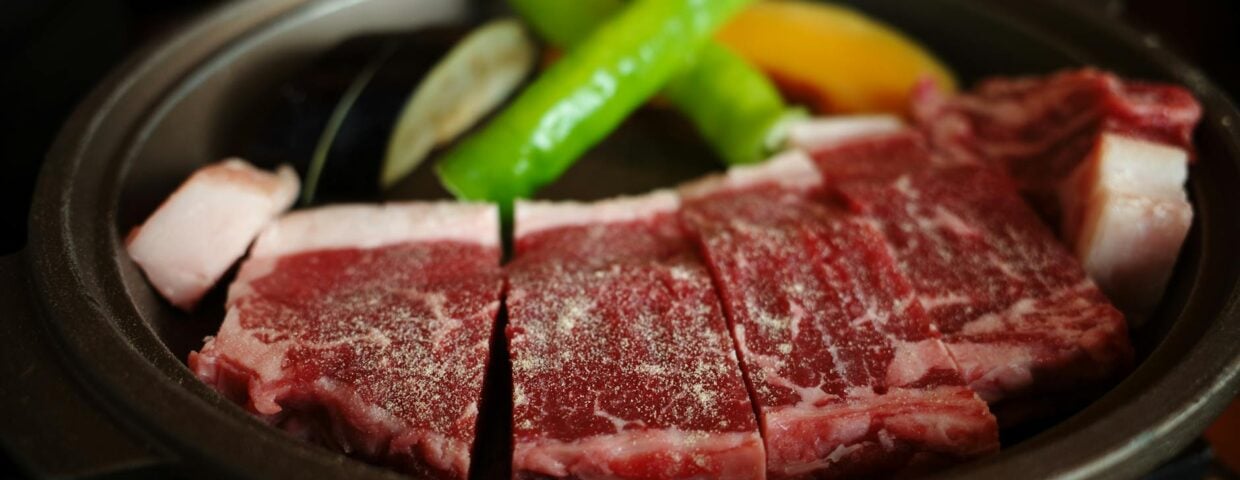
Yakiniku (tabletop grill): You grill your own cuts at the table over charcoal or gas. The interactivity is part of the experience — you control the cook, you eat at your pace, you order additional cuts as you go. Yakiniku restaurants that specialise in wagyu will bring cuts pre-portioned and offer guidance on optimal cooking time. The short rib (karubi), tongue (tan), and chuck roll (kata rosu) are typically the first things to order.
Teppanyaki: The chef cooks on an iron griddle in front of you. This is the theatrical option — skilled teppanyaki chefs perform as they cook. The preparation is precise and the cuts are usually larger than shabu-shabu or yakiniku portions. It’s the format most international visitors associate with Japanese steak, though it’s less common domestically than yakiniku.
Wagyu steak (Western-style): Some wagyu restaurants serve in a straightforward Western format — steak, sides, sauce. This is a legitimate choice but note that A5 wagyu at high portions (200g+) can become overwhelming given the fat content. A 100–150g portion of A5 prepared correctly is more enjoyable than a 300g portion of the same. Many good wagyu restaurants serve smaller portions deliberately.
Wagyu sushi and nigiri: A specific preparation worth seeking out — a thin slice of lightly torched or raw wagyu placed on vinegared rice. Found at wagyu specialists and, notably, at market stalls in Takayama and Kyoto’s Nishiki Market.
What Wagyu Actually Costs in Japan
The range is wider than most people expect.
High-end restaurant (Kobe/Matsusaka beef, full course): ¥15,000–40,000 per person. This is the full omakase-style experience at a certified specialist.
Mid-range yakiniku restaurant (A4–A5 wagyu by the cut): ¥5,000–12,000 per person for a satisfying meal with multiple cuts.
Lunch set menu: Many wagyu restaurants offer lunch at 30–40% of the dinner price for similar quality. A wagyu lunch set at a good restaurant — two to three cuts, rice, sides — can be ¥3,000–6,000.
Market stalls: Takayama’s morning markets and Kyoto’s Nishiki Market have wagyu nigiri and skewers for ¥500–1,500. Not the same as a full restaurant experience, but a legitimate way to taste high-quality wagyu without the full commitment.
Convenience store: Wagyu-flavoured or wagyu-grade convenience store items exist and are predictably not the same. Skip.
The practical advice: book a lunch rather than a dinner at a wagyu specialist. You’ll eat the same quality beef in the same restaurant for significantly less. Use the saving on sake.
Where to Eat Wagyu in Japan
Kobe: The obvious destination for Kobe beef. Restaurants in Kobe’s Kitano and Sannomiya areas display their Kobe beef certification. Ishida, Wakkoqu, and Mouriya are long-established and respected. Look for the Kobe beef certificate on display.
Osaka: Osaka has excellent yakiniku culture and multiple wagyu specialists. The Tsuruhashi neighbourhood (Osaka’s Korean quarter) has a high concentration of yakiniku restaurants and is a good place to eat wagyu casually and well for less.
Tokyo: Every wagyu brand is represented in Tokyo restaurants. Ginza and Nishiazabu have high-end teppanyaki and course-meal wagyu restaurants. Nakameguro and Shimokitazawa have mid-range yakiniku specialists.
Takayama: For the Hida beef experience at a market stall — an accessible, memorable way to eat great beef without the restaurant overhead.
Matsusaka: The city exists primarily as a wagyu destination. It’s a half-day trip from Nagoya. Worth planning if the beef is a priority.
The One Thing Most People Get Wrong
Ordering the highest grade available and then eating a 250g steak.
Very high BMS wagyu (BMS 11–12) at that portion size becomes a test of how much rich fat you can eat before the richness starts working against you. The Japanese approach — small portions, often shared, across multiple cuts — is the right approach not for cultural reasons but for gustatory ones. A tasting of five small cuts tells you more and tastes better than a single large cut.
Let the restaurant guide you. If they offer a tasting course, take it. If they recommend the lunch set, consider it. Wagyu restaurants that have been doing this for decades know how their beef is best enjoyed.
For the full context of eating well in Japan — from ramen to convenience stores to izakayas — see the Japan Food Guide.
External references:
- Kobe Beef Marketing and Distribution Promotion Association — the official body that certifies Kobe beef and lists authorised restaurants
- Japan Meat Grading Association — the official grading authority; the full grading standards are published here