If you ask most people outside Japan to name a Japanese noodle, they say ramen. Ramen has had an exceptional decade of international exposure — dedicated restaurants, documentary coverage, global recognition of regional styles. Udon has not had that. This is an injustice of a modest but real kind, because in Japan, udon is not a lesser noodle. It is a parallel tradition of equal seriousness, different character, and — in some regions — deeper historical roots.
In Kagawa Prefecture on Shikoku island, udon is not a dish. It is effectively the culture. Within the Japan food guide, it sits alongside ramen as one of the two great noodle traditions. Understanding that, and understanding the range of what udon can be, makes it considerably more interesting than its international reputation suggests.
What Udon Actually Is
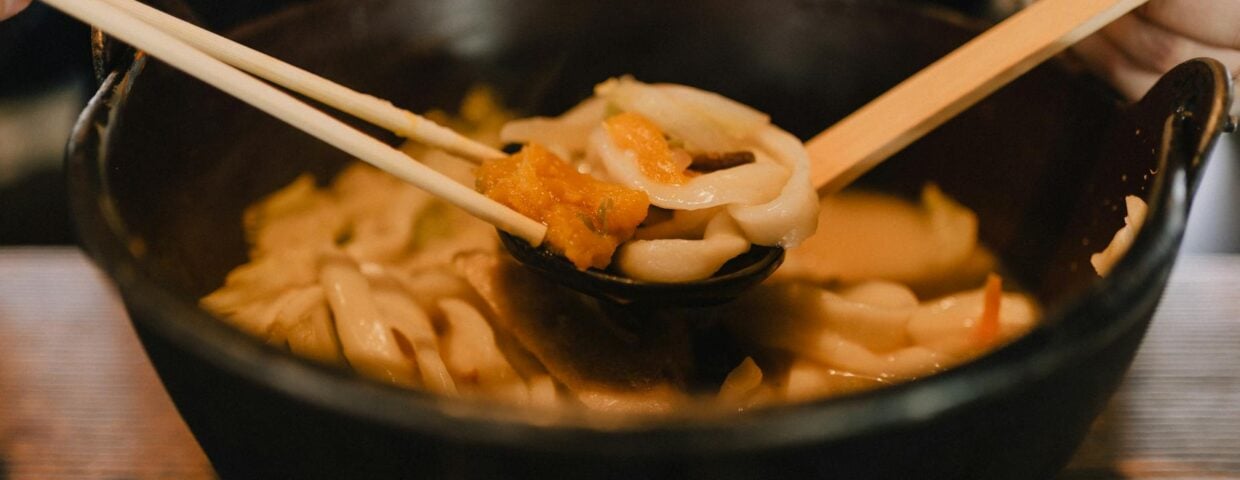
Udon is a thick wheat noodle, made from flour, water, and salt. The thickness varies by region and style, but it is always substantial compared to soba or ramen noodles — a proper udon noodle is a significant presence in the bowl. The texture ranges from soft and yielding to firm and chewy depending on how it is made and cooked; Sanuki-style udon from Kagawa tends toward the firmer end, which surprises people expecting something softer.
The dashi broth — made from kombu (kelp) and katsuobushi (dried bonito), or in some Kansai shops from kombu alone — matters as much as the noodle. A pale, clear Kansai broth that appears almost uncoloured carries enormous flavour depth from the kombu and a delicacy that takes a moment to register. This is not a neutral base; it is the point. The broth announces the region you are eating in.
Sanuki Udon: The Pilgrimage
Kagawa Prefecture, on the northeast corner of Shikoku island, is where udon is taken most seriously in Japan. The prefecture has more udon shops per capita than anywhere else in the country. Locals eat udon for breakfast. Udon shops open at 5 or 6am and sell out by midday. Going to Kagawa specifically for udon — the Sanuki udon pilgrimage — is a recognised and accepted purpose for travel among Japanese people.
Sanuki udon (named for the historic province that corresponds to Kagawa) has a particular character: firm, with a slightly translucent surface when freshly made, and a satisfying resistance when you bite through it. It is served in various ways — in a light dashi broth (kake style), cold on a bamboo tray with a separate dipping broth (seiro or zaru style), or at some shops in a very minimal format where you take the noodles in a bowl, add your own cold dashi from a jug, and top with spring onion and ginger from a communal condiment counter.
The prices in Kagawa are startling to anyone used to Tokyo or Osaka. A bowl of udon at a local shop costs ¥300–500. Even the most celebrated shops in the prefecture operate at these prices. This is not tourist pricing; this is what udon costs in a place where it is an everyday food.
Takamatsu is the main city in Kagawa and the practical base for an udon trip. It is approximately 45 minutes from Okayama by Shinkansen (Okayama is on the Tokaido/Sanyo Shinkansen line), and Okayama is accessible from Osaka in around 45 minutes. A day trip from Osaka or Kyoto to Takamatsu for udon is entirely feasible; an overnight stay allows you to hit more shops, including the ones that open at dawn.
Well-known shops in the area include Yamashita Udon and Udon Baka Ichidai — both are frequently cited by Japanese food guides. Note: many Kagawa udon shops are cash only, some do not have English menus, and several are in locations that require a taxi or rental car to reach. Bring cash in small denominations. The official Kagawa Prefecture tourism site has a dedicated Sanuki udon guide with English support and shop listings.
The Kansai-Kanto Broth Divide
One of the most instructive ways to understand Japanese regional food culture is to order a plain kake udon in Osaka and then order the same thing in Tokyo. The bowls will look different. They will taste meaningfully different. The noodles may be similar; the broth will not be.
Kansai broth (the style of Osaka, Kyoto, and the surrounding region) is light and almost clear — barely coloured by the soy sauce added at the end of preparation. The flavour is forward on kombu umami, clean, and relatively delicate. A Kansai udon broth is designed to show off the dashi.
Kanto broth (Tokyo and the east) is darker, richer, more aggressively seasoned with soy sauce. It is a more assertive bowl — immediately savoury, less subtle, more filling in feel. Neither is wrong; they reflect different regional taste preferences that have centuries of history behind them. Most Japanese people have a preference based on where they grew up. Most non-Japanese visitors prefer one without necessarily knowing why.
This divide is one of the recurring expressions of the Kansai-Kanto cultural difference that runs through Japanese food generally. It shows up in soy sauce colour, in miso type preference, in the way ramen broth is constructed. Udon makes it most visible because the broth is the bowl.
Types of Udon: What to Order
Kake udon is the simplest form: plain noodles in hot broth, topped with spring onion and perhaps a sprinkle of shichimi (seven-spice powder). It is the baseline from which everything else is judged. If a shop’s kake udon is good, the shop is good.
Zaru udon / seiro udon is cold udon served on a bamboo tray or in a cold water bath, with a separate dipping broth (tsuyu) for dunking. This is the form that shows the noodle’s texture most clearly — there is no hot broth softening it, and the chewiness is the point. Good in summer.
Kitsune udon — “fox udon” — is topped with aburage: a piece of seasoned, sweetened fried tofu that has been simmered in dashi. The name comes from folklore associating foxes with fried tofu. This is a specifically Osaka specialty in its best form; the Kansai version of kitsune udon has a broth and tofu balance that does not quite translate to other regions. At a good Osaka udon shop, it is the order to make.
Niku udon is udon with meat — in the Kansai version, this means thinly sliced beef simmered in sweet soy sauce, placed on top of the bowl. The sweetness of the beef and the delicacy of the Kansai broth work together. This is a different proposition from the Tokyo version, which uses a darker broth and often different beef preparation.
Curry udon is exactly what it sounds like: a thick, curry-flavoured broth, substantial and warming. It is better than people expect. The curry is Japanese-style — sweeter and milder than Indian curry — and the udon noodles hold up well to the thick sauce. It will stain a white shirt. Order accordingly.
Tempura udon adds a piece of tempura — usually prawn, sometimes mixed vegetable — on top of a bowl of kake udon. The tempura is better when freshly fried than when it has been sitting. At shops that make tempura to order, this is a genuinely good bowl.
Udon vs Ramen: A Different Register
The comparison comes up often, and the honest answer is that they are not in competition — they are different moods. Ramen is an aggressive bowl: rich, often fatty, complex in construction, satisfying in a heavy way. You leave a ramen meal feeling filled. Udon is lighter, cleaner, the noodle is the primary element rather than the broth, and the experience of eating it is less intense. It suits different times of day and different states of hunger.
Ramen tends to be dinner or late-night food in Japan. Udon is breakfast, lunch, a quick stop. In Kagawa, the udon shops open at dawn because that is when people eat udon — it is the morning meal, not the evening one. This is not a hierarchy; it is a difference in function.
Marugame Seimen: The Chain That’s Worth Mentioning
Marugame Seimen is a national udon chain with hundreds of locations across Japan (and internationally). It is cafeteria-style: you move along a counter, pick your broth type and size, add toppings and tempura from a display, pay, and find a seat. The noodles are made fresh in an open kitchen visible from the counter.
This is a legitimate introduction to udon. The noodles are good for a chain, the variety is broad, the prices are very low (a basic bowl from ¥400), and the open kitchen format lets you see the noodles being made. It is not the same as a specialist shop in Kagawa, but it is honest, consistent, and widely available. For a first experience with udon or a quick lunch, it is not a compromise — it is the right tool.
For the full context of Japanese food culture and how udon fits within it, our Japan food guide covers the regional logic. If you are planning a broader trip to Japan, our Japan travel guide has the practical framework. And if ramen is also on the itinerary, our ramen guide covers the styles and regions in the same depth.
Udon rewards the same attention that ramen has received internationally. The regional variation is real, the quality ceiling is high, and the Kagawa pilgrimage is one of the more specific and satisfying food travel experiences Japan offers.