Street food in Japan is not a category of convenience. It’s one of the most rewarding parts of the Japan food guide to actually live. It is a system of place and season so precise that the same city can feel like an entirely different eating experience depending on what month you arrive. A stall selling grilled corn at a summer festival in Kyoto in July is a different proposition entirely from the same stall in March. The food is the same; the meaning is not. That is what separates Japanese street food from almost everywhere else.
Most writing about street food in Japan reduces it to a list of snacks to photograph. That misses the point. The best way to understand it is to follow the logic: where you are, what season it is, and what the local food identity demands of that moment.
The Matsuri Season and What It Means for Street Food
Japanese festivals — matsuri — are the peak of street food culture, and summer is when it concentrates. The three largest in the country happen in quick succession: Gion Matsuri in Kyoto throughout July (the processions peak mid-month), Tenjin Matsuri in Osaka on July 24–25, and Awa Odori in Tokushima on Shikoku from August 12–15. Each draws hundreds of thousands of people. Each generates kilometres of festival stalls — yatai — selling almost identical food in almost identical booths.
What you find at matsuri stalls is fairly consistent across Japan: yakisoba (stir-fried noodles with cabbage and pork), takoyaki, kakigori (shaved ice), taiyaki, grilled corn, ikayaki (grilled squid), chocolate-dipped bananas, frankfurters. The cooking is fast, the portions are designed for eating while walking, and the atmosphere is the point as much as the food. This is not where you go for the best version of any dish. This is where the dish and the moment are inseparable.
Timing matters. Gion Matsuri in July turns central Kyoto — particularly Shijo-dori and the streets north of it — into a pedestrian market from around 6pm until late. The stalls are dense, the crowds are dense, and the heat is significant. The food you want in that context is cold (kakigori, cold ramune soda) or small and hot enough to eat in two bites (takoyaki, taiyaki). Festival food logic is weather logic.
Osaka: Identity on a Skewer and in a Ball
Osaka is the centre of gravity for Japanese street food. Not because it has the widest variety — Tokyo does — but because food is central to Osaka’s sense of itself in a way that is unusual even by Japanese standards. The phrase kuidaore (eat until you drop) applies to the city’s relationship with eating generally, and street food specifically. For the full picture of what drives this, see our Osaka food guide.
Dotonbori is where tourists go first, and it is not wrong to go there — but know what you are doing. The canal district is dense with food stalls and restaurants, many of which are mediocre and expensive. The best approach: ignore the places with illuminated plastic food displays and find the smaller operators with queues of Japanese people. The takoyaki from a good small operator in Dotonbori is genuinely excellent.
Takoyaki deserves a proper explanation. The batter — a thin, dashi-seasoned flour mixture — is poured into a cast-iron mould with hemispherical cups. A piece of octopus goes in, along with tenkasu (tempura scraps), pickled ginger, and green onion. The cook uses metal picks to rotate each ball as the batter sets, creating a sphere that is crisp outside and liquid inside. The finished balls are brushed with takoyaki sauce (similar to okonomiyaki sauce, sweet and slightly sharp), mayonnaise, dried seaweed powder, and katsuobushi — dried bonito flakes that wave and curl in the heat of the freshly sauced balls. Eating them immediately is the correct approach. They do not improve with time.
Shinsekai, the neighbourhood south of central Osaka that most tourists skip, is where kushikatsu culture lives. Kushikatsu — deep-fried skewers of meat, seafood, and vegetables in a thin panko breadcrumb coating — is Shinsekai’s dish. The chain Daruma claims to have invented it. Whether or not that is accurate, the neighbourhood remains the place to eat it. The rule is absolute and posted on signs in most kushikatsu shops: no double-dipping in the communal sauce. You dip once. If you want more sauce, use the cabbage leaves provided to scoop it. The variety of skewers available is wide — pork belly, prawn, lotus root, cheese, quail egg, asparagus — and the correct approach is to order a few at a time and keep going.
Kyoto: Nishiki Market and What to Actually Eat There
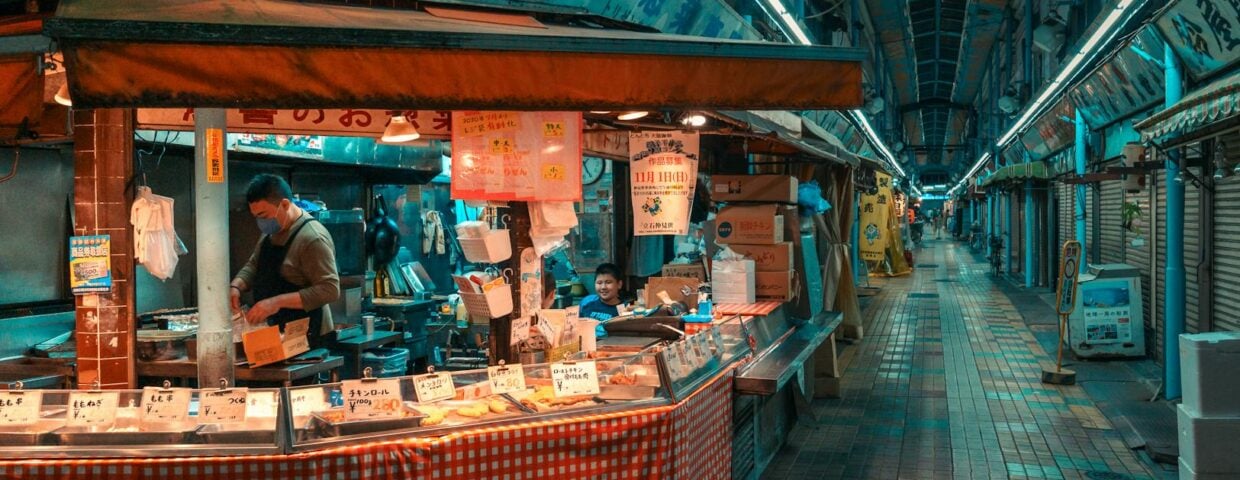
Kyoto’s street food is more restrained than Osaka’s, which fits the city. The main street food destination is Nishiki Market — a covered arcade running east-west between Teramachi and Takakura, five blocks north of Shijo. It is called “Kyoto’s Kitchen” and has been a food market for four centuries. It is also, increasingly, a tourist market, and the balance has shifted over the past decade.
What is worth eating: grilled tofu skewers (firm tofu, light char, soy glaze — simple and good), tsukemono (Kyoto pickles, best bought loose to try a piece), fish-on-a-stick from stalls selling grilled seafood, and the various cooked items sold by individual shops. The tako tamago — a small octopus with a quail egg in its head, on a skewer, sold by one specific stall — is famous and worth trying. Yuba (tofu skin) in various forms appears frequently; Kyoto’s version tends to be fresher and more delicate than what you find elsewhere.
The practical issue: Nishiki is a narrow covered arcade, and eating while walking creates congestion. Some stalls have small standing areas. The convention is to eat near where you bought something, not to drift through the whole market eating as you go.
Tokyo: Asakusa, Harajuku, and the More Diffuse Street Food Scene
Tokyo’s street food is less concentrated geographically than Osaka’s. The best pockets are in older neighbourhoods.
Asakusa, the area around Senso-ji temple, has the densest traditional street food scene in Tokyo. Ningyo-yaki — small baked cakes filled with red bean paste, moulded into shapes (traditional designs include the Asakusa temple gate and pigeons) — are the signature item, sold from shops along Nakamise-dori. They are good: slightly caramelised outside, dense anko inside. Also in Asakusa: melonpan (a sweet bread roll with a thin cookie crust that gives it a melon-rind appearance — no actual melon, though melon-cream versions exist), and various grilled items from the small stalls around the temple precincts.
Harajuku (specifically Takeshita-dori) is where the more performative street food lives — enormous cotton candy sculptures, crepes packed with fruit, ice cream and whipped cream. The Harajuku crepe is worth understanding: a thin crepe wrapped into a cone, filled with whipped cream, custard, fruit, and often ice cream. It has been a Harajuku fixture since the 1970s and the execution at the better stalls is good.
Fukuoka: Yatai Culture After Dark
Fukuoka has something that no other major Japanese city has to the same degree: a functioning, large-scale outdoor yatai (stall) culture that operates primarily in the evening and late into the night. The main concentration is along Nakasu island, a small strip of land between two rivers in central Fukuoka, and around Tenjin. Around 150 yatai operate across the city.
A Fukuoka yatai is a small covered stall, usually seating eight to twelve people on stools, serving food and drinks. The menu typically includes Hakata ramen (the local style — tonkotsu broth, thin straight noodles), yakitori, oden, and various small dishes. The atmosphere is close and communal in a way that is specific to this format. You sit next to strangers under the same canvas, order from a cook working a metre in front of you, and stay for as long as you like.
The yatai operate from around 6pm and most keep going until 1–2am, some later. They are not tourist installations — they are where people in Fukuoka eat and drink in the evening. Visiting one is one of the more specific and worth-doing street food experiences in Japan. For broader context on Japanese festivals and seasonal food, our festivals guide covers the full calendar.
Foods Worth Understanding Properly
Taiyaki is a fish-shaped waffle — not a fish-flavoured one. The shape is that of a sea bream (tai), and the interior is filled with anko (sweet red bean paste) in the classic version. Custard and sweet potato fillings are also common. The batter is pressed in a cast-iron mould and cooked until the exterior is golden and slightly crisp. Temperature matters: hot from the iron is significantly better than one that has been sitting.
Yakitori is charcoal-grilled chicken skewers, but the category is more interesting than that description suggests. The different cuts available at a proper yakitori stall represent the entire bird: momo (thigh — the standard, reliable, good fat content), kawa (skin — rendered slowly over charcoal until crisp, underrated), nankotsu (cartilage — a texture thing, crunchy, requires commitment), tsukune (minced chicken patty, often with egg yolk for dipping), negima (thigh with spring onion alternated). Seasoning is either tare (a sweet soy glaze) or shio (salt) — shio works better for cuts with good fat, tare for leaner pieces.
Kakigori at a specialist shop is categorically different from festival machine shaved ice. The best shops use natural ice shaved on a hand-turned or slow electric blade to produce a texture closer to fresh snow than ice. The syrups are housemade. Common combinations: matcha with condensed milk, strawberry with condensed milk, yuzu with honey. Some shops add toppings of anko, mochi, or shiratama dumplings. The season is short — most specialist kakigori shops open for summer only. The queues at the best ones form before opening.
Practical Notes
Eating while walking in Japan is generally accepted at festivals and in tourist areas, less so in normal street contexts. Some areas — parts of Kyoto, parts of Nara — have posted signs asking people not to eat while walking due to crowds. Outside of those zones, common sense applies.
Pricing: most street food items fall in the ¥300–800 range per item. Takoyaki (6 or 8 pieces) typically runs ¥500–700. Taiyaki ¥200–300. Yakitori ¥150–250 per skewer. Festival stalls price slightly higher than shops. Cash remains the safest assumption at street stalls, though card payment is increasingly available at permanent market stalls.
The broader context for understanding Japanese food — the regional logic, the seasonal principles, what to eat in each city — is in our Japan food guide. For the official festival calendar and event details, Japan Tourism Agency’s travel site is the most reliable source.
The reward for engaging with Japanese street food on its own terms — seasonal, regional, local — rather than as a bucket list is a materially better eating experience. Pay attention to where you are and when you are there, and the food makes more sense.