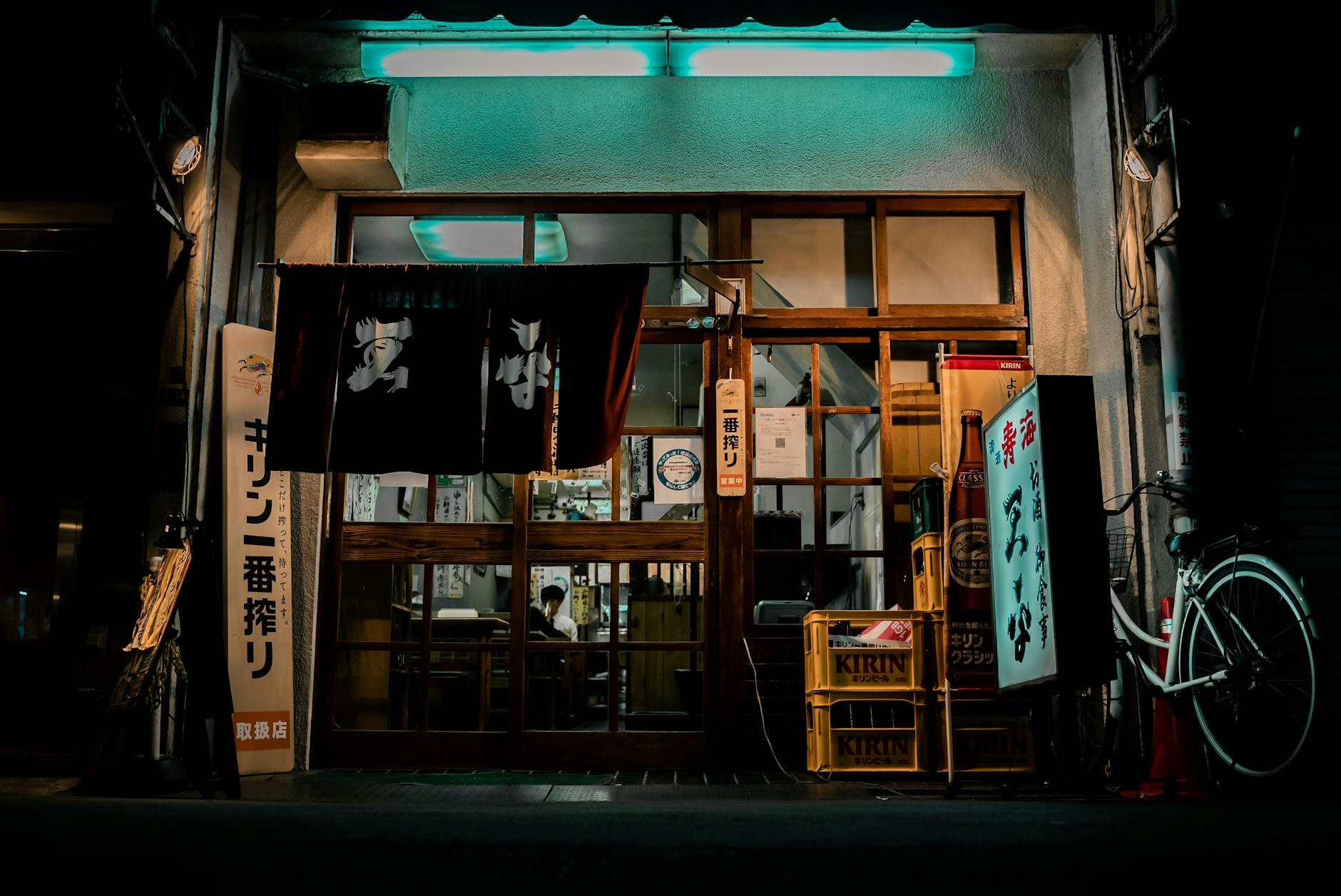
There’s a particular moment in a good izakaya when the noise reaches the right pitch — conversations overlapping, someone laughing too loud, the clatter of plates, the sharp smell of yakitori on the grill — and you understand why the Japanese consider this one of life’s pleasures. It’s not a bar. It’s not a restaurant. It’s something that sits between the two and serves as a social institution unto itself.
The izakaya (居酒屋 — literally “stay-sake-shop”) is where Japan goes after work. Where friendships are maintained, deals quietly sealed, frustrations vented, and the careful formality of daytime life temporarily set aside. For visitors, it’s also one of the most accessible entry points into actual Japanese food culture — not the curated version, but the everyday one.
This guide covers how to walk into one confidently: how to order, what to eat, how the drinking customs work, and what the unwritten rules are that most tourist guides skip.
What Is an Izakaya?
The izakaya emerged in the Edo period (1603–1868) from sake shops that began letting customers drink on-site. Over three centuries it evolved into a distinct category of establishment with its own culture, menu structure, and social codes.
What distinguishes an izakaya from a restaurant:
- Food is ordered in small dishes, shared across the table, in rounds rather than all at once
- Alcohol drives the pacing — food is the accompaniment, not the reverse
- The atmosphere is intentionally informal, even in expensive izakaya
- Tables are occupied for hours, not turned over
- The menu is typically seasonal and hand-written or chalked on boards
What distinguishes an izakaya from a bar:
- Food is as central as drink — skipping food would be unusual
- Seating is usually table-based, not bar-only
- The social unit is a group, typically colleagues or friends
- Japanese bars (バー, ba) are quieter, more curated, focused on cocktails and whisky
Types of Izakaya
Chain Izakaya
The large chains — Torikizoku, Watami, Shoya, Kushikatsu Tanaka, Uotami — are everywhere and offer a reliable, affordable experience. Typically ¥3,000–¥5,000 per person for food and drinks. Menus often have tablet ordering in multiple languages. Good for a first experience or for solo dining.
Shotengai and Neighborhood Izakaya
Small, owner-operated places in covered shopping arcades, back streets, and station-adjacent alleys. Often no English menu. Often the best food. The master (taisho) may be the only person running the kitchen and bar simultaneously. These places have regulars who’ve been coming for decades. If you’re warmly received, it means something.
Yakitori-ya
Specializes in grilled skewers (yakitori) — technically a subset of izakaya. The best ones are counter seats only, with the chef grilling directly in front of you over binchotan charcoal. Order piece by piece. Don’t rush. The chicken liver skewers and tsukune (chicken meatball) are usually the best things on the menu.
Robatayaki
Grilled seafood and vegetables over an open hearth — the staff sometimes pass food to customers on long wooden paddles. Theatrical and extremely good. More expensive than standard izakaya (¥5,000–¥10,000+ per person).
Standing Bars (Tachinomi)
No seating — you drink standing at counters or barrels. Extremely cheap (beer from ¥300). Common near train stations. Usually open from late afternoon. The social interaction is condensed — conversations start naturally with strangers. An excellent introduction to how Japanese people actually drink.
How to Enter and Get Seated
Walk in and call out sumimasen or wait to be greeted with irasshaimase (welcome). The staff will ask how many people (nan-mei sama desu ka). You can hold up fingers. You’ll usually be asked about smoking preference — kinen (no smoking) or kitsuensha (smoking). Smoking is still allowed in many izakaya in designated areas.
You’ll typically be given oshibori (a wet towel — hot in winter, cold in summer), a menu, and possibly a small appetizer (otoshi or tsukidashi). This appetizer is not optional — it’s a table charge (¥300–¥500 per person) that appears automatically. Don’t be surprised by it on the bill.
How to Order
Drinks First — Always
The first order is always drinks. Toriaezu biiru — “first, beer” — is practically a ritual phrase. Even if you don’t drink beer, ordering something immediately signals you’re ready. Options:
- Nama biiru — draft beer (usually Asahi, Sapporo, or Kirin)
- Chu-hai — shochu mixed with soda and fruit, low alcohol, usually cheap
- Highball (haiboru) — whisky and soda, typically Suntory Toki or Kakubin
- Sake (nihonshu) — hot (atsukan) or cold (reishu), often in small carafes (tokkuri)
- Shochu — Japan’s most consumed spirit, distilled from sweet potato, barley, or rice. Lower-calorie and cheaper than sake.
- Oolong-hai — shochu with oolong tea. The go-to if you want something light.
- Soft drinks — always available, no stigma in Japan for not drinking alcohol
Food — In Rounds, Shared
Order a few dishes to start, then continue ordering as you go. The food comes out as it’s ready — not in a particular sequence. Share everything. Nobody has “their” dish in an izakaya — the table eats together.
Refills: you do not pour your own drink. You pour for others; others pour for you. Watch the glasses around the table and refill when you notice someone running low. This is one of the fundamental social choreographies of izakaya dining.
Calling the Staff
Say sumimasen — loudly enough to be heard. Pressing a call button (common at chains) is also standard. Don’t wave or snap fingers.
What to Order: The Izakaya Menu
Essential Izakaya Dishes
Edamame — Boiled salted soybeans. The default opening order. ¥300–¥500.
Karaage — Japanese fried chicken, marinated in soy and ginger before frying. Consistently excellent at any decent izakaya. Often served with kewpie mayo and lemon.
Yakitori — Grilled chicken skewers. The spectrum: momo (thigh), negima (thigh and leek), tsukune (meatball), kawa (skin), reba (liver), hatsu (heart), nankotsu (cartilage). Order seasoned with either shio (salt) or tare (sweet soy glaze).
Sashimi moriawase — Assorted raw fish, usually three to five varieties. Quality varies significantly by izakaya. Fish-specialist izakaya are worth seeking out for this.
Tamagoyaki — Sweet rolled omelette, often served as a starter. Deceptively difficult to make well — how it’s executed tells you a lot about the kitchen.
Tofu dishes — Agedashi tofu (lightly battered and fried, in dashi broth) or hiyayakko (cold tofu with condiments). Light, inexpensive, frequently excellent.
Gyoza — Pan-fried dumplings. Usually made in-house at good izakaya. Dip in a mixture of soy sauce, rice vinegar, and ra-yu (chili oil).
Nabe (hotpot) — Available in winter. A shared pot of broth at the table, into which you add vegetables, tofu, and meat or seafood. Requires advance ordering at some places.
締め (shime) — the final dish: Traditionally, izakaya meals end with a carbohydrate to “close” the stomach — ochazuke (rice in green tea), ramen, onigiri, or a simple rice bowl. It’s customary but not mandatory.
The Bill
Ask for the bill with okaikei onegaishimasu or make the universal “write on the palm” gesture. Bills are almost always brought to the table — you don’t pay at a register in izakaya. Payment is usually split evenly (warikan) regardless of exactly who ordered what, especially in Japanese groups. If you want separate bills, ask at the start of the evening (betsubetsu de onegaishimasu) — after the fact, it gets complicated.
Practical Information
- Hours: Most open from around 17:00–18:00, close at midnight or later. Some are open until the last train.
- Cost: Budget ¥2,500–¥4,000 per person at a mid-range izakaya, all-in.
- Solo dining: Completely normal. Counter seats are standard. You will be left alone and served attentively.
- Reservations: Not needed at most chain izakaya. Recommended for popular independent places, especially Friday/Saturday evenings.
- English menus: Available at chains and many tourist-area izakaya. Increasingly rare at neighborhood places — have Google Translate ready on your phone.
Best Cities for Izakaya
Osaka — The city’s kuidaore (eat until you drop) philosophy means izakaya here are particularly focused on food quality. The Namba, Shinsaibashi, and Tenma areas have excellent density.
Fukuoka — The yatai (outdoor food stalls) in Nakasu and along the Naka River are a specific Fukuoka institution that functions like an outdoor izakaya. Yakitori and ramen side-by-side under canvas, late into the night.
Tokyo — Shinjuku’s Omoide Yokocho (Memory Lane), the alleys behind Shibuya station, and the izakaya clusters around any major station. Yurakucho under the train tracks has some of the most atmospheric options in the city.
Kyoto — Pontocho, the narrow alley running parallel to the Kamo River, has high-end izakaya with some of the best seasonal food in Japan. The Fushimi area is known for sake production and has local izakaya with exceptional nihonshu selection.
For broader context on Japanese food and drinking culture, see the Japanese food culture guide. And for the full picture on experiencing Japan as a visitor, see the Japanese culture and traditions guide.
The definitive external resource on izakaya food and culture remains japan-guide.com’s izakaya overview, which covers regional variations in detail. For sake pairing and Japanese drinking culture specifically, the Wikipedia entry on izakaya has useful historical context.