Japan’s public transport is one of the best in the world — punctual, clean, extensive. It’s also confusing if you don’t know the system. Once you do, getting around becomes second nature. Here’s how it all works.
IC Cards: The Foundation
An IC card is a rechargeable contactless card that pays for trains, buses, taxis, konbini purchases, and vending machines across Japan. You tap on, tap off, and the fare is deducted automatically. No ticket machines, no exact change, no stress.
The major IC cards by region:
- Suica — issued by JR East, centered on Tokyo and Kanto region
- Pasmo — issued by Tokyo Metro and private Kanto lines; interchangeable with Suica
- ICOCA — issued by JR West, standard for Osaka, Kobe, Kyoto and Kansai
- Manaca — Nagoya region
- Hayakaken — Fukuoka
- Kitaca — Sapporo/Hokkaido
The key fact: all major IC cards now work across the entire country’s IC-compatible network. Your Osaka ICOCA works fine on Tokyo’s JR and Metro lines. Your Suica works at Osaka konbini. Regional separation is mostly historical. Get whichever card is sold at your nearest station when you arrive.
Children (6-11) get a child IC card at half the adult fare. Students with commuter passes (定期券) get discounted rates loaded onto their IC card for fixed routes.
How to Top Up
Top up at any IC card machine in any station. Insert cash (coins or notes), select your amount (1,000-10,000 yen increments typically), and tap your card. You can also load money at konbini registers and, if you have a Japanese bank account linked to your IC card, via the mobile app (Suica app for iPhone Apple Pay or Google Pay works well).
Minimum balance for a standard Suica is 500 yen deposit (non-refundable while you hold the card, returned if you surrender it). Keep at least 1,000-2,000 yen loaded to avoid the awkward card-decline moment at the gate during rush hour.
JR vs Private Lines: The Confusion
This trips up newcomers constantly. Japan’s railways aren’t one unified system — they’re dozens of separate companies operating different lines, often through the same stations.
JR (Japan Railways) is the national carrier, privatized into regional companies (JR East, JR West, etc.). Most bullet train (shinkansen) lines are JR. The Yamanote Line in Tokyo is JR.
Private lines (Tokyu, Keio, Hankyu, Kintetsu, Odakyu, etc.) often run parallel or connecting routes that are cheaper than JR. Osaka’s Hankyu and Kintetsu networks are far more useful than JR for many inner-city trips. In Tokyo, private lines dominate the suburbs.
Your IC card works on all of them. The fare difference between JR and private lines for the same journey can be 20-40%. Google Maps will show you the cheapest route option if you select “cheapest” rather than “fastest.”
Google Maps for Japan Transit
Google Maps is excellent for Japan transit. Select public transport mode, and it shows line names, platform numbers, required transfers, and exact fares. The IC fare shown is what you’ll actually pay with your card — accurate to the yen.
Yahoo! Transit (ヤフー乗換案内) is popular among locals and sometimes handles edge cases and delays better. Both work offline if you’ve cached your area.
Shinkansen Basics
The shinkansen (bullet train) network connects most major cities. It’s fast — Tokyo to Osaka in 2.5 hours vs 8+ hours by regular train — but priced accordingly. Tokyo-Osaka unreserved seat: around 13,870 yen (~$92). Reserved seats cost slightly more.
Your regular IC card covers the base rail fare on shinkansen but not the express surcharge. Most people buy a separate shinkansen ticket at the station or via the EX-IC app (requires Japanese credit card). For tourists, the JR Pass covers unlimited shinkansen travel for a set period — but for residents, it’s rarely the best deal.
Last Train Culture
Trains in Japan stop running around midnight and restart around 5am. Missing the last train is a genuine event — it means a taxi home (expensive), walking (possibly long), or sleeping at a manga cafe until first trains. “Last train” time is posted at every station. Everyone knows their last train time for their route. You should know yours.
In Tokyo, the Yamanote Line last train from Shibuya is around 12:30-1:00am depending on direction. Check the timetable for your specific station and direction — it varies.
Rush Hour
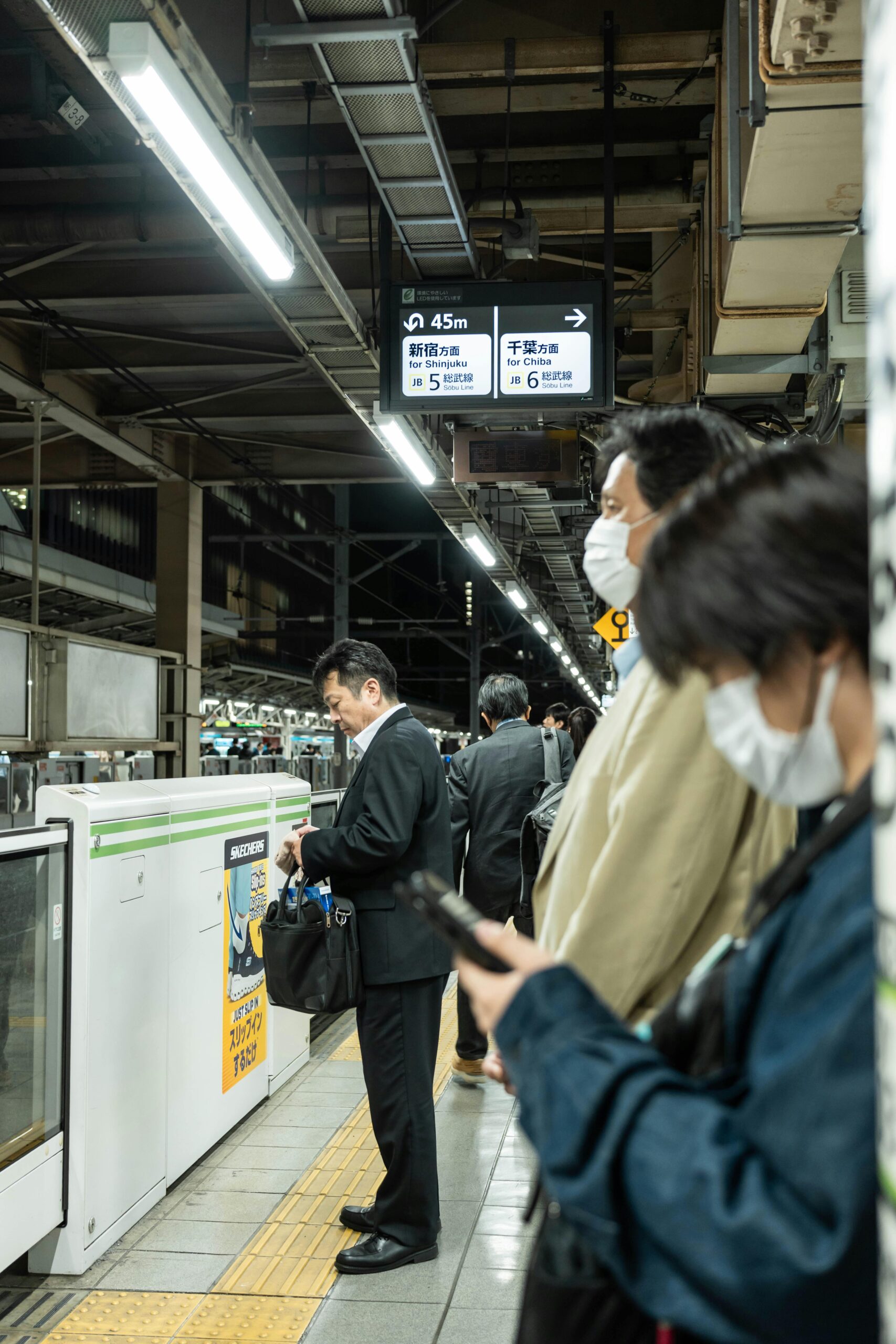
7:30-9:30am on weekday inbound trains to major city centers. Some lines reach 180-200% capacity. It’s exactly what you’ve seen in videos. Tips: let people exit before entering, step fully into the car, face the same direction as everyone else, keep your bag in front of you. Nobody speaks. Nobody meets eyes. It works.
IC Card for Tourists vs Residents
As a resident with a Japanese bank account, set up your IC card on Apple Pay or Google Pay. Top up automatically, never carry cash for transit or convenience store purchases. The mobile Suica or PASMO is significantly more convenient than a physical card.
For transit costs and how they fit into your monthly budget, the cost of living in Japan breakdown includes typical monthly transport spending. And for the full picture of life as a resident, the living in Japan hub connects all the pieces. If you’re planning a trip rather than a move, the Japan travel guide covers everything from transport to itineraries.